Ah, Pétanque. For some, it’s “something French,” for others, it’s a childhood game played in the courtyards of Provence, and for true fans, it’s a way of life. Imagine: a noisy group of people, a mug of cold cider on a bench, the sun, gravel under your feet, and the clang of iron balls flying toward a tiny wooden ball. In moments like these, it seems like life has turned out well.
But behind all this atmosphere lie clear rules and a tradition as old as French wine. Let’s figure out how to play Pétanque so that you can immediately feel the excitement and not look like a confused beginner.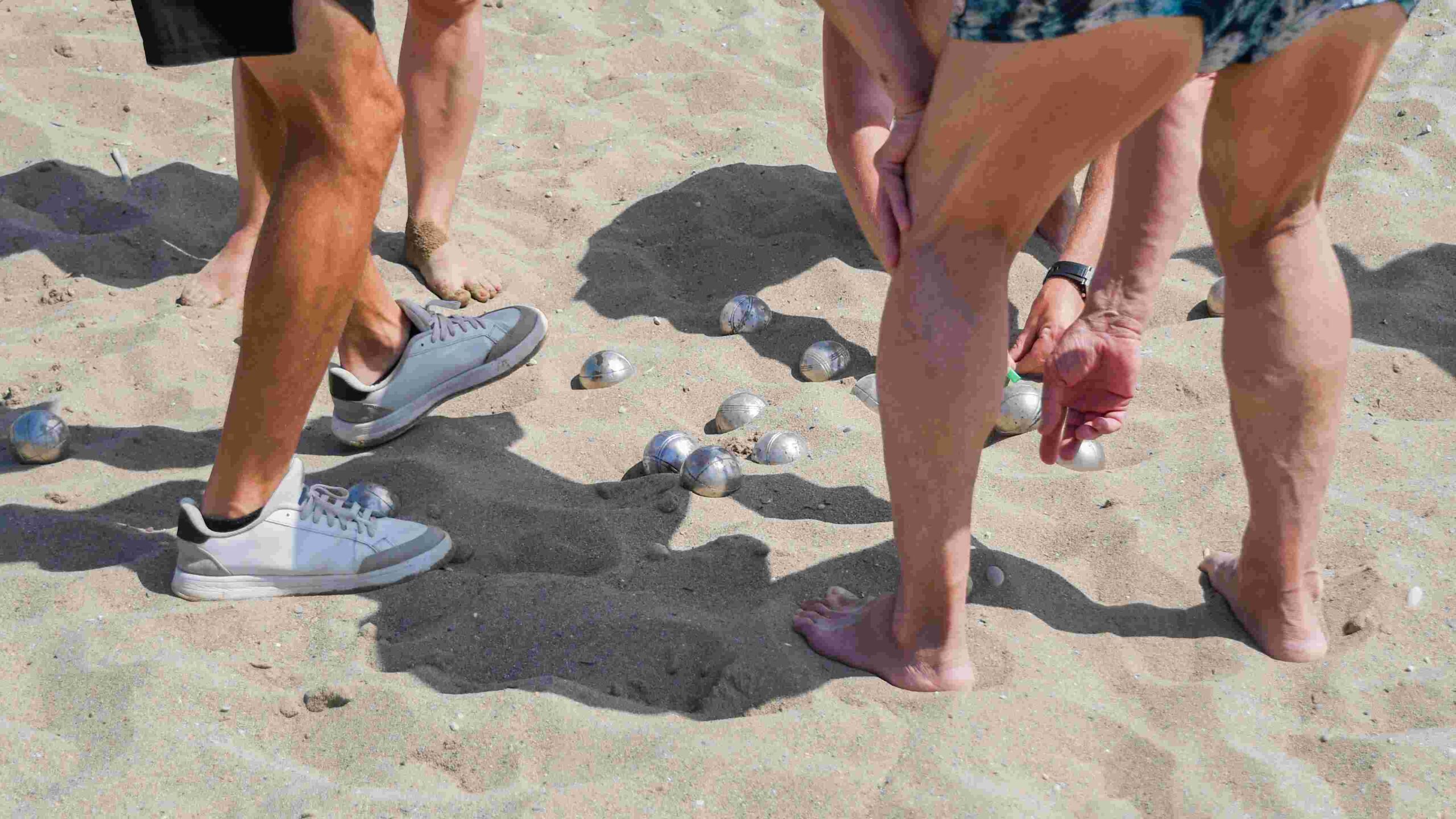
What is Pétanque, and why is it special?
Pétanque is a ball game in which two teams try to place their metal boules as close as possible to a small wooden cochonnet (or, as it is often called, a “piglet”). Unlike bowling or curling, there are no perfectly flat lanes or ice rinks. On the contrary, Pétanque is played on the ground (on gravel, sand, or compacted soil). Any bump or pebble becomes part of the game.
The metal balls weigh about 700 grams and are approximately 74 mm in diameter. Each team plays either in “singles” (one on one), ‘doubles’ (two on two), or “triples” (three on three) format. The number of balls depends on the format: three per player in singles and doubles, and two in triples.
This simple math makes the game accessible: all you need is a few balls, a flat playing field, and a willingness to argue about whose ball is closest to the jack.
Game mechanics
The beginning of a game of Pétanque is like the prologue to a play. A coin toss decides everything. The team that wins the toss chooses a spot and draws a circle with a diameter of 35-50 cm on the ground. Players throw all their balls from this circle.
First, the jack is thrown. It must fly 6-10 meters, but remain at least one meter away from any obstacle. At this point, the strategy begins: if you throw too far, you risk missing; if you throw too close, you give your opponent a chance to beat you easily.
Throws
The game is based on alternating throws.
- The player throws the first ball and tries to place it next to the cochonnet.
- Opponents come out and try to “beat” the success: either place their ball closer or knock out someone else’s.
- The move remains with the team whose balls are further from the target. They continue throwing until they get closer or run out of boules.
There is a subtle point here: throws are not strictly taken in turn. Sometimes one team makes two or three throws in a row, while the other team just watches. This is what creates tension and makes each game like a little show.
Scoring
Once all the balls are on the ground, the scoring begins. The team whose ball is closest to the jack wins the round. But it’s not enough to just win. Points are awarded for each ball that is closer to the target than the opponent’s closest ball.
For example, if you have three balls and your opponents have none nearby, you immediately get three points. The maximum in a game is 13 points. Have you reached this milestone? You can celebrate your victory to applause.
Technique and style
In Pétanque, a lot depends on the style of the throw.
- There is the “plage”: a soft throw calculated for a precise landing.
- There is the ‘carreau’: a sharp, powerful throw aimed at knocking out an opponent’s ball.
- There is also the “lob,” when the ball is thrown in a high arc so that it lands right next to the jack, jumping over all obstacles.
Each throw is a small drama, where accuracy and composure are decisive.
Atmosphere of Pétanque
The secret to the game’s success lies in its ability to bring people together. You can play in the yard with your neighbors, on the beach, in the park, in the courtyard of a bar, or right in the town square. The playing field does not require any special preparation, which makes Pétanque as democratic as possible.
There is a saying in Provence: “Every Frenchman always has three balls in his trunk.” And there is truth in this: all you need is a couple of minutes and some company to start a game anywhere.
Why fans love Pétanque
Players who have tried Pétanque once tend to stick with it for a long time. It’s all about the spirit of the game and its special style.
- The simplicity of the rules makes it accessible to all ages.
- The atmosphere of friendship and friendly competition turns the game into a celebration.
- The ability to play anywhere makes it universal.
Strategy and technique add depth, so the game never gets boring.
Little tricks for beginners
If you decide to try your hand at Pétanque, here are a few tips:
- Keep your body relaxed, don’t tense up.
- Throw with your whole body for more control.
- Learn to read the field: gravel, pits, and pebbles can work for or against you.
- Don’t be afraid to take risks: sometimes the best move is to knock out your opponent.
Pétanque is a game that combines the simplicity of backyard fun with the depth of real strategy. It’s important to be able to feel the moment, read the field, and anticipate your opponent. It’s also a game that brings people together: on a bench in the shade, by a sandy playground in the park, or on a noisy street.
So grab some metal balls, call your friends, and give it a try. One game and you’ll understand why millions of people around the world have long been in love with Pétanque.